
There is a moment that every giant breed owner experiences, usually around the six-month mark, when they look at their puppy and think: "This cannot possibly get any bigger." The puppy will then spend the next twelve to eighteen months proving them spectacularly wrong. I have worked with large breed dogs for over two decades, and the single most common mistake I see new owners make is fundamentally underestimating what "giant" actually means.
When we talk about giant breed dogs, we are not discussing animals that are simply larger than average. We are talking about creatures that occupy a different scale entirely. A fully grown Great Dane can weigh more than an adult human. A Mastiff can exceed 200 pounds. An Irish Wolfhound, standing on its hind legs, can look a tall man directly in the eye. These are not dogs that fit neatly into the spaces designed for typical pets.
Understanding the Growth Timeline
Giant breeds grow differently than smaller dogs, and understanding this timeline is essential for managing expectations. A Labrador Retriever reaches physical maturity around twelve months. A Great Dane may continue growing until they are two or even three years old. This extended growth period creates a unique challenge: you will spend years living with a dog whose body is constantly changing.
During the first year, giant breed puppies can gain ten pounds per month. I have seen Mastiff puppies that weighed fifteen pounds at eight weeks balloon to over one hundred pounds by their first birthday. This rapid growth is not just a matter of size; it profoundly affects everything from joint development to feeding requirements.
The growth plates in giant breed dogs remain open much longer than in smaller breeds. This means that the skeleton is still developing, still vulnerable, during a period when the dog already weighs as much as an adult Golden Retriever. This biological reality has significant implications for exercise, nutrition, and daily management that many new owners do not anticipate.
Growth Rate Comparison
A typical Great Dane puppy weighs approximately one pound at birth. By adulthood, they may exceed 150 pounds, representing a weight increase of 15,000 percent. Compare this to a Chihuahua, which might go from four ounces to six pounds, an increase of roughly 2,400 percent. The mathematics of giant breed growth are simply staggering.
The Physical Reality of Size
Numbers on a page do not adequately convey what living with a giant breed dog actually feels like. Let me try to make it tangible. When a 150-pound Newfoundland decides to lean against you while you are sitting on the couch, you feel the weight. When an Irish Wolfhound wants to greet you at the door, you need to brace yourself. When a Saint Bernard shakes after drinking water, everyone within a six-foot radius gets wet.
This size affects every aspect of daily interaction. Grooming a giant breed is a full-body workout. Bathing one requires either a dedicated dog wash station or a willingness to get as wet as the dog. Nail trimming, which many owners handle themselves with smaller breeds, often requires two people and careful positioning with a giant breed simply because of the leverage and strength involved.
The tail of a happy Great Dane operates at roughly coffee-table height and carries enough momentum to clear surfaces, leave bruises on legs, and terrify small children. This is not aggression; it is simply physics. A fifty-pound tail attached to a hundred-fifty-pound dog, wagging with enthusiasm, is a force to be reckoned with.
Weight Management Fundamentals
Managing weight in giant breeds requires vigilance that borders on obsession. Every extra pound a giant breed carries translates to exponentially increased stress on joints, bones, and internal organs. An overweight Mastiff is not just a heavy dog; it is a dog heading toward early joint deterioration, heart problems, and a shortened lifespan. Our nutrition guide for giant breeds explains proper feeding to maintain healthy weight.
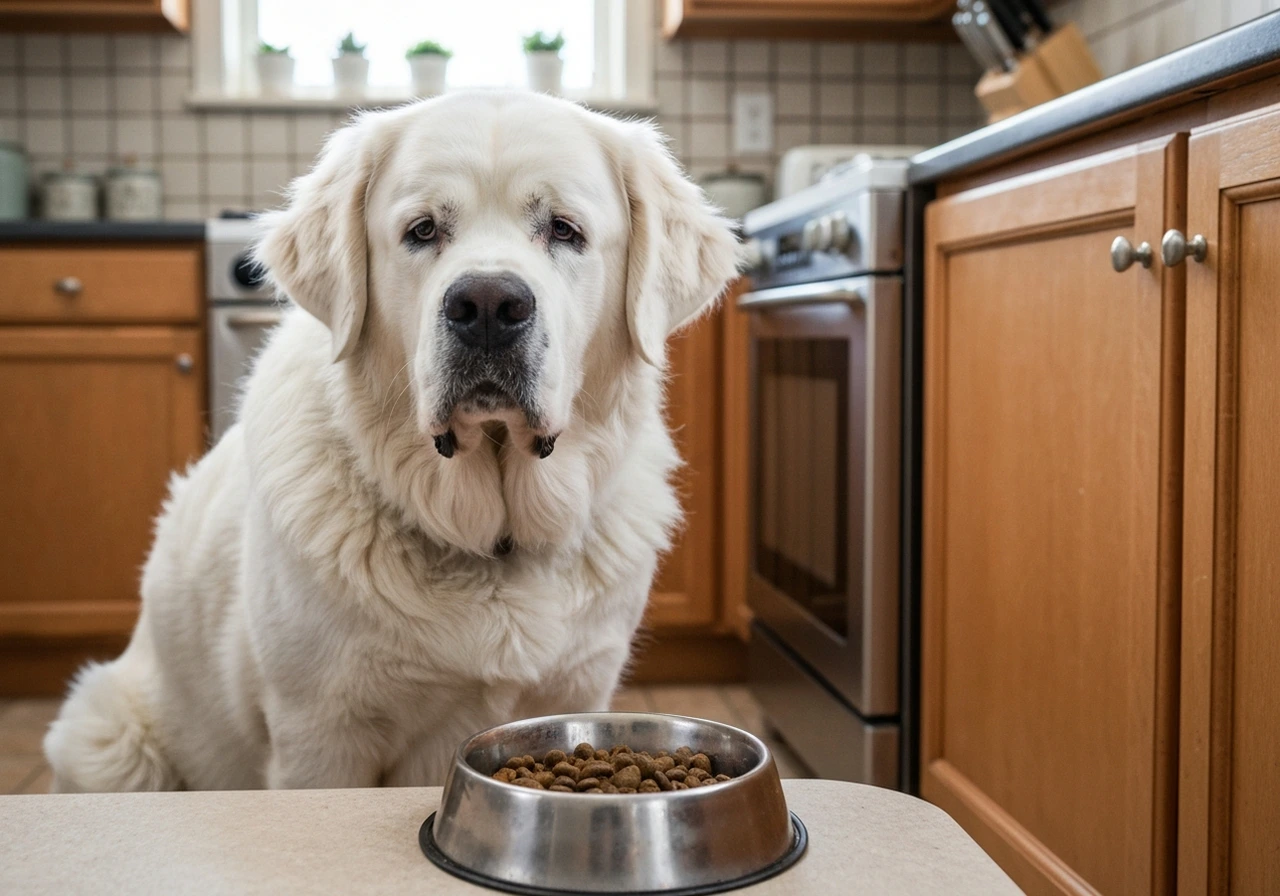
The challenge is that giant breeds often do not look overweight even when they are. Their sheer size makes it difficult to visually assess body condition. I recommend learning to evaluate body condition by feel rather than sight. You should be able to feel your dog's ribs without pressing hard, but they should not be prominently visible. There should be a visible waist when viewed from above and a tucked abdomen when viewed from the side.
Feeding giant breeds appropriately is both a science and an art. They require more food than smaller dogs, obviously, but not proportionally more. A dog that weighs twice as much as another does not need twice as much food; metabolic rate does not scale linearly with body weight. Overfeeding a giant breed puppy is particularly dangerous because excess weight during the growth phase can cause permanent skeletal damage.
Critical Feeding Guidelines
Never free-feed a giant breed puppy. Controlled portions at scheduled times allow you to monitor intake and adjust as needed. Rapid weight gain during the growth phase can lead to developmental orthopedic diseases that will affect your dog for life. Slow, steady growth is the goal, even if it means your puppy looks lean compared to others of the same age.
Strength and Control Considerations
A giant breed dog that pulls on leash is not just inconvenient; it is potentially dangerous. A 180-pound dog that decides to chase a squirrel can pull an adult human off their feet. This is not an exaggeration; I have seen it happen more times than I can count. The physical strength of these dogs demands respect and requires training that begins early and remains consistent.
Leash training a giant breed should start the moment the puppy comes home. The goal is to establish walking habits before the dog reaches a size where bad habits become unmanageable. A twelve-week-old Great Dane puppy that pulls on leash is a minor inconvenience. A one-year-old Great Dane that pulls on leash is a legitimate safety hazard. Our guide to positive training for giant breeds covers effective techniques for leash training and more.
Equipment matters enormously. Standard collars and leashes designed for average dogs may not be appropriate for giant breeds. Harnesses that distribute pressure across the chest are often better for dogs that still pull, and the construction needs to be robust enough to handle the forces involved. I have seen leashes snap and collars fail under the sudden load of a giant breed lunging unexpectedly.
Spatial Requirements Reality Check
The popular notion that giant breeds need vast amounts of space is partially wrong and partially right. It is true that a Great Dane lying stretched out on the floor takes up an enormous amount of square footage. It is also true that many giant breeds are surprisingly calm indoors and adapt well to smaller living spaces, provided they receive adequate exercise.
What giant breeds absolutely require is furniture and equipment scaled to their size. A dog bed for a Mastiff is not a dog bed; it is a mattress. A crate for a Great Dane is the size of a small car. Food and water bowls need to be elevated and large enough that the dog can eat and drink comfortably. These are not luxury considerations; they are basic necessities for the dog's comfort and health.
The turning radius of a giant breed in motion is substantial. A Newfoundland executing a tight turn in your kitchen will contact walls, cabinets, and anything at counter height. Tail clearance requires at least three feet in all directions, more for the particularly enthusiastic breeds. Living with a giant breed means either redesigning your space or accepting a certain amount of chaos.
The Gentle Giant Reality
Despite their imposing size, many giant breeds earn the designation "gentle giant" honestly. Great Danes are often remarkably careful around children and small animals. Newfoundlands have an almost preternatural gentleness that has made them legendary as nanny dogs. Saint Bernards, for all their bulk, tend toward a calm, patient temperament that makes them excellent family companions.
However, gentleness does not eliminate the physical reality of size. A gentle giant that steps on your foot still hurts. A gentle giant that tries to sit in your lap still weighs 150 pounds. The kindest, most careful Mastiff can still knock over a toddler simply by walking past. Size is a constant factor that no amount of good temperament can fully mitigate.
Training a giant breed to be aware of its own body is possible and valuable. Teaching dogs to move carefully around small children, to sit or lie down in crowded situations, and to be conscious of their mass can significantly reduce accidental injuries. But this awareness must be trained; dogs do not naturally understand that they are larger than the creatures around them. For families with children, our guide on child safety with large breeds provides essential protocols.
The Lap Dog Paradox
Nearly every giant breed believes, in its heart, that it is a lap dog. This is simultaneously one of the most endearing and most challenging aspects of living with these dogs. The 180-pound Mastiff that wants to curl up in your lap for comfort does not understand why this presents a problem. Learning to accommodate this need while managing the physical logistics is one of the great adventures of giant breed ownership.
Long-term Size Management
As giant breeds age, size management takes on new dimensions. Senior giant breeds often struggle with mobility, and their size makes it difficult or impossible for owners to physically assist them. A 150-pound dog that can no longer climb stairs on its own presents a problem that a 30-pound dog in the same situation does not.
Planning for senior years should begin while the dog is still young. Consider accessibility of your home. Ground-floor living arrangements are preferable. Ramps and assistive devices should be acquired before they are urgently needed. Some owners invest in lifting harnesses that allow them to support a portion of their dog's weight during movement.
The lifespan of giant breeds is generally shorter than smaller dogs, which is a difficult reality that prospective owners must accept. A Great Dane has an average lifespan of 7-10 years. A Mastiff typically lives 6-10 years. This is not a reason to avoid giant breeds, but it is a factor that affects the emotional calculus of ownership.
Preparing for Giant Breed Life
If you are considering adding a giant breed to your family, prepare for the reality rather than the fantasy. Visit with adult dogs of the breed you are considering. Spend time with owners who can speak honestly about the challenges. Calculate the food costs, the veterinary costs, the equipment costs. Measure your doors, your car, your available floor space.
Understand that you are not just getting a large dog; you are fundamentally changing the logistics of your daily life. From how you arrange furniture to how you plan vacations, a giant breed touches everything. This is not a burden for those who love these dogs; it is simply the price of admission to one of the most rewarding relationships in the canine world.
The rewards of giant breed ownership are substantial. These dogs offer a presence, a companionship, and often a gentleness that smaller breeds cannot match. They become not just pets but genuine physical presences in your home and life. For the right owner, the challenges of managing their size are vastly outweighed by the joy of sharing space with these magnificent animals.
Ready to understand the health considerations specific to these gentle giants? Continue with our comprehensive guide on essential health knowledge for giant breed owners. You will also want to explore space planning for giant dogs for practical home setup advice.
If finances are a consideration, review the budget reality of large breed ownership before bringing a giant breed home.