
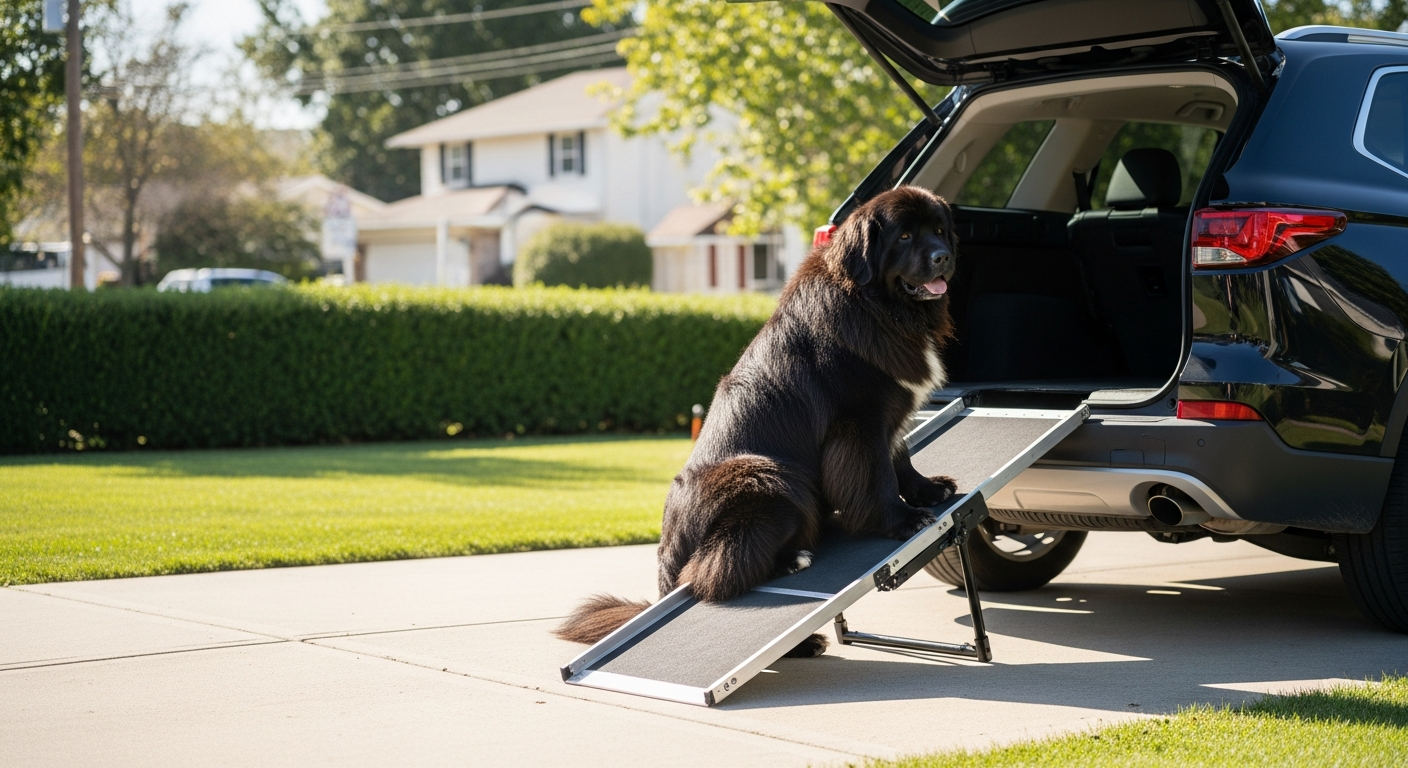
A 150-pound dog does not fit in a sedan. That single sentence captures a category of life-with-giant-breed problem that surprises most first-time owners. Vets, groomers, emergency clinics, pet-friendly parks, training classes - these all require transport, and transport that works for a Labrador often fails entirely for a Great Dane, Mastiff, or Newfoundland. This article covers what actually works for moving a giant breed dog safely and comfortably, including vehicle selection, restraint systems, loading logistics, and the specific challenges of long-distance travel.
Vehicle Selection: What Actually Fits
Before you shop for a crate, measure your dog lying down in full lateral recumbency. Add six inches of length and four inches of height to get the minimum crate dimensions. Then shop for a vehicle whose cargo area will accept a crate of those dimensions with the front-to-back orientation necessary for stable loading. Most owners skip this step, buy a crate that looks big enough standing up, and then discover that their Dane cannot stretch out for the three-hour drive to the emergency vet.
The vehicles that actually work for giant breeds fall into three tiers. The first tier is full-size SUVs and crossovers with folding rear seats and a flat cargo floor: Chevrolet Tahoe, Ford Expedition, Toyota Sequoia, Cadillac Escalade. These accept a 48-inch giant-breed crate with room for a passenger up front and some cargo. The second tier is minivans: Honda Odyssey, Toyota Sienna, Chrysler Pacifica. Minivans are the unsung heroes of giant-breed ownership because of the wide side-door access, low load floor, and massive cargo capacity. Removing a third-row seat typically creates enough space for a 54-inch crate with clearance for another dog beside it. The third tier is full-size vans: Ford Transit, Mercedes Sprinter, RAM ProMaster. These are overkill for a single dog but become the right choice for multi-dog households or breeders who transport whelping litters.
Station wagons and crossover SUVs with sloping rear glass - Subaru Outback, Honda CR-V, Toyota RAV4 - are marginal for giant breeds. A Newfoundland fits in the back of a CR-V only if the dog curls up, and a dog who cannot stretch out on a three-hour drive will stand stiff at the destination. Avoid the marginal vehicles if you have a choice. Do not buy a sedan and assume your Great Dane will adapt; it will, but not comfortably, and not safely.
Crash-Tested Restraint Systems
The Center for Pet Safety is a non-profit that crash-tests pet restraint products and publishes the results at centerforpetsafety.org. Most pet seatbelts and harnesses on the market fail the basic Federal Motor Vehicle Safety Standard 213 crash test. The products that have passed include the Sleepypod Clickit Sport harness and the Gunner Kennel crates. For giant breeds specifically, the Gunner G1 Intermediate is rated to 110 pounds and the G1 Large is rated up to 150 pounds; above that weight, crates are custom-ordered from specialised manufacturers.
The important insight is that an unrestrained 150-pound dog in a 35 mph collision becomes a 3,500-pound projectile by basic physics. Unrestrained dogs kill themselves, their owners, and passers-by in vehicle crashes at rates that make pet restraints one of the highest-return safety investments in dog ownership. A Gunner crate costs $600 to $900 for the giant-breed sizes. A total loss of a beloved dog and a family member in a preventable crash is priceless. The math is not close.
Harness-style restraints using a connection to the vehicle seat belt are the less expensive alternative and have legitimate use cases, especially for dogs who cannot physically fit a crate of the required size in the owner's vehicle. The Sleepypod Clickit Sport harness is crash-tested and will hold a giant breed in a moderate impact. It will not protect the dog in a severe rollover in the way a crate will, but it is far better than nothing and is a reasonable compromise for vehicles where a crate is simply not possible.
Loading and Unloading: The Ramp Conversation
A giant breed dog jumping into and out of a vehicle tailgate accumulates orthopedic wear at a rate that translates into clinical problems over the dog's lifetime. The back-of-napkin math is that a 150-pound Mastiff jumping down from a 30-inch tailgate produces roughly 450 pounds of peak impact force through the carpus and elbow on landing. Over hundreds of entries and exits per year, over ten years, this is a measurable contributor to the osteoarthritis that eventually shows up in every giant breed who has been transported without assistance.
Pet ramps with adequate weight ratings (at least 200 pounds for a Mastiff or large Newfoundland), non-slip surfaces, and a gentle grade (less than 20 degrees) solve this problem. Telescoping ramps from Solvit, Pet Gear, and PetSafe are all usable; the key specifications are the weight rating, the length (longer is gentler), and the folded storage dimension. Ramp-training a giant breed takes two to four weeks of patient reinforcement. Start on the ground, build up to a curb, build up to the low tailgate of a minivan, eventually build up to the higher tailgate of an SUV. Older dogs ramp-train faster than puppies because the incentive is clearer; dogs with early hip or elbow discomfort often volunteer onto the ramp the first time it is offered.
Lifting a 150-pound dog into a vehicle is physically unsustainable and risks both owner and dog. I have seen more owner back injuries from dog-lifting than from any other activity, and the emergency vet visits for dogs dropped mid-lift are more common than anyone wants to admit. A ramp is not a luxury. For a giant breed in daily transport, it is required equipment. This parallels the broader home setup considerations for giant breeds, where physical logistics drive the whole plan.
Road Trip Realities
Taking a giant breed on a multi-day road trip adds layers of logistical complexity that shorter trips do not expose. Hotel availability is the first challenge. Not all "pet friendly" hotels accept dogs over 50 pounds, and even fewer accept dogs over 100 pounds. The chains with the most consistent policies for giant breeds are Best Western, Motel 6, La Quinta, and Kimpton; Red Roof Inn and Extended Stay America are also usually flexible. Verify by phone before booking. Online filters lie about size policies more often than they admit.
Restaurant stops require more thought. Leaving a 150-pound dog in a vehicle is dangerous in any ambient temperature above 65°F because of radiant cabin heating; below 40°F, the reverse risk emerges for short-coated giants. Plan stops at locations with outdoor dining that accept dogs, drive-through-only meals consumed in the vehicle with the dog, or hotels where the dog can rest in-room during meal breaks. The BringFido directory is the most comprehensive resource for outdoor-dog-friendly restaurants in North America.
Hydration and bathroom stops require more frequent service for giant breeds than for smaller dogs. The combined urinary bladder capacity and drinking rate of a 150-pound Mastiff is enough that four-hour stretches between stops are the upper limit; two-to-three-hour stops are more comfortable. A portable water bowl and a gallon of familiar water kept in the vehicle avoids the hotel-tap-water-induced soft stools that plague dogs on unfamiliar municipal water supplies.
Temperature management is the most important travel safety issue for giant breeds. Double-coated giants (Newfoundland, Saint Bernard, Great Pyrenees) can overheat at cabin temperatures that feel ordinary to a human. Plan driving hours in the early morning and evening during summer months; run the vehicle AC at moderate rather than high settings to avoid creating a humidity gradient inside the crate; never leave the dog in a parked vehicle for more than the briefest errand, and only with the AC running if leave is truly unavoidable. The American Veterinary Medical Association guidance at avma.org gives the specific temperature thresholds worth memorising.
Air Travel
Air travel for giant breeds is limited and complicated. Most U.S. airlines will not accept dogs over 100 pounds (including crate weight) in cargo. International flights with giant breeds typically require ground transit to a European carrier (Lufthansa, KLM) that will accept large dogs in cargo, followed by careful coordination with the destination country's import rules. IPATA-registered pet relocators are the professional route and cost $3,000 to $8,000 for a single international move; they handle documentation, approved crates, temperature window compliance, and customs clearance.
I do not recommend flying a giant breed as a standard practice. The heat-related deaths in cargo holds are a published statistic, and the stress response in dogs of that size is disproportionately high. If the move is unavoidable, use a professional service. If the move is optional, consider whether the trip is worth it.
The Bigger Picture
Giant breed transport is not an afterthought. It is a design constraint on the life you can share with a giant breed dog. Prospective owners should audit their current vehicle, their home's parking logistics, and their routine travel patterns before committing to a 150-pound dog. Many excellent homes adapt. Some homes cannot. The dogs who fail in transport-related households fail for reasons the owner did not see coming.
For those who do make it work, the reward is a lifestyle where a dog of extraordinary presence moves through the world beside you with the same ease as any other companion. Get the vehicle right, get the restraints right, install the ramp, and the logistics fade into the background of a life well lived with a gentle giant.